


I’m glad to be back from a great week of vacation and looking forward to resuming our Monday Bible teaching next week. But returning home meant stepping back into the cultural fray, and the angry rhetoric surrounding author J.K. Rowling’s latest essay caught my attention. There’s something revealing about the way our culture responds when someone dares to say what should be obvious, and I think it’s worth pointing out.

If you didn’t know, J.K. Rowling has become one of the most reviled women in the Western world – a fall from grace that would have seemed unthinkable in the first two decades of this millennium, when she enjoyed near-universal public adoration. Her crime? Making the rather unremarkable observation that biological sex is real, that women have legitimate interests in maintaining female-only spaces, and that redefining words cannot change the realities those words describe.

In an update to the June 2020 essay that first ignited the firestorm around her views on sex and gender, Rowling reflected on what has changed (and what hasn’t) in the years since. Gay writer Dennis Noel Kavanagh praised the new piece as “important, heartfelt and magisterial as ever,” singling out her “characteristic unerring accuracy” in analyzing the class dynamics of gender ideology.
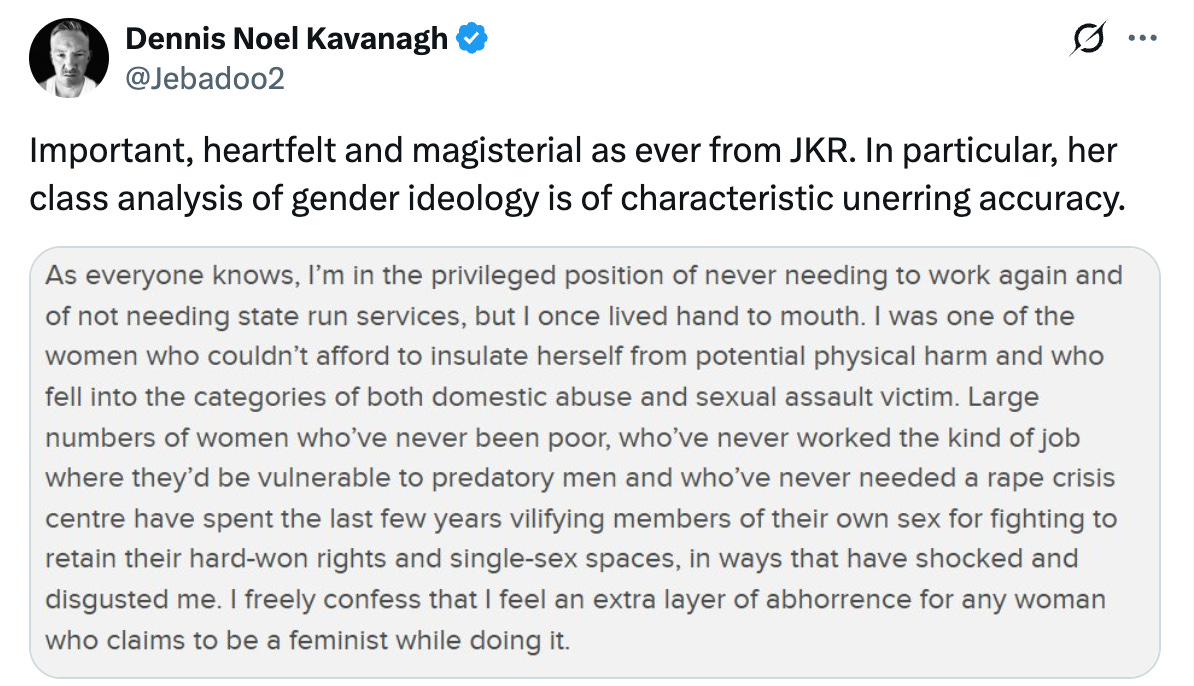
He’s right. What makes Rowling’s writing so compelling is that she repeatedly returns to observations grounded in ordinary experience that should hardly need defending.
Yet here we are.
Rowling points out that women’s rights are not an abstract philosophical exercise that involve theoretical inconveniences. They involve privacy, safety, fairness, and dignity. She also identifies something revealing about the gender ideology movement that has made her a pariah. What began as demands for tolerance and compassion has become an insistence that everyone affirm a particular understanding of human identity, regardless of biological reality or the consequences for others. Question that understanding, and you risk being branded hateful or bigoted.
Rowling isn’t making a religious argument, yet the controversy she describes points toward a deeper spiritual question.
We often assume disagreements like gender identity are primarily intellectual, that the solution is better information, clearer definitions, or a more persuasive argument. Scripture offers a more troubling diagnosis.
In Romans 1:18, Paul writes that people “suppress the truth by their wickedness.” He’s not describing people who don’t know the truth, but people who suppress the truth they know. The problem isn’t that we need to be informed, it’s that we don’t want reality to limit what we desire.

That is a matter of the heart, not of the mind.
When our desires become more important than truth, we demand that reality conform to us rather than conforming ourselves to reality. That means language must change, institutions must comply, and those who refuse to participate must be silenced or shamed.
Once again, Christianity provides the better way.
God tells us that our desires are often misleading, and that freedom comes only in submission to the moral, physical, and spiritual order He has defined and revealed.

The controversy surrounding Rowling tells us we have reached a point at which stating what many once regarded as an obvious truth will now be treated as an act of extraordinary provocation.
But it’s important to understand this is happening not because we have forgotten how to recognize reality but because we have come to resent reality for refusing to become whatever we wish it to be.