


“Is this real, or is it propaganda?”
That’s the question my daughter sent me the other day alone with this screenshot she saw online:
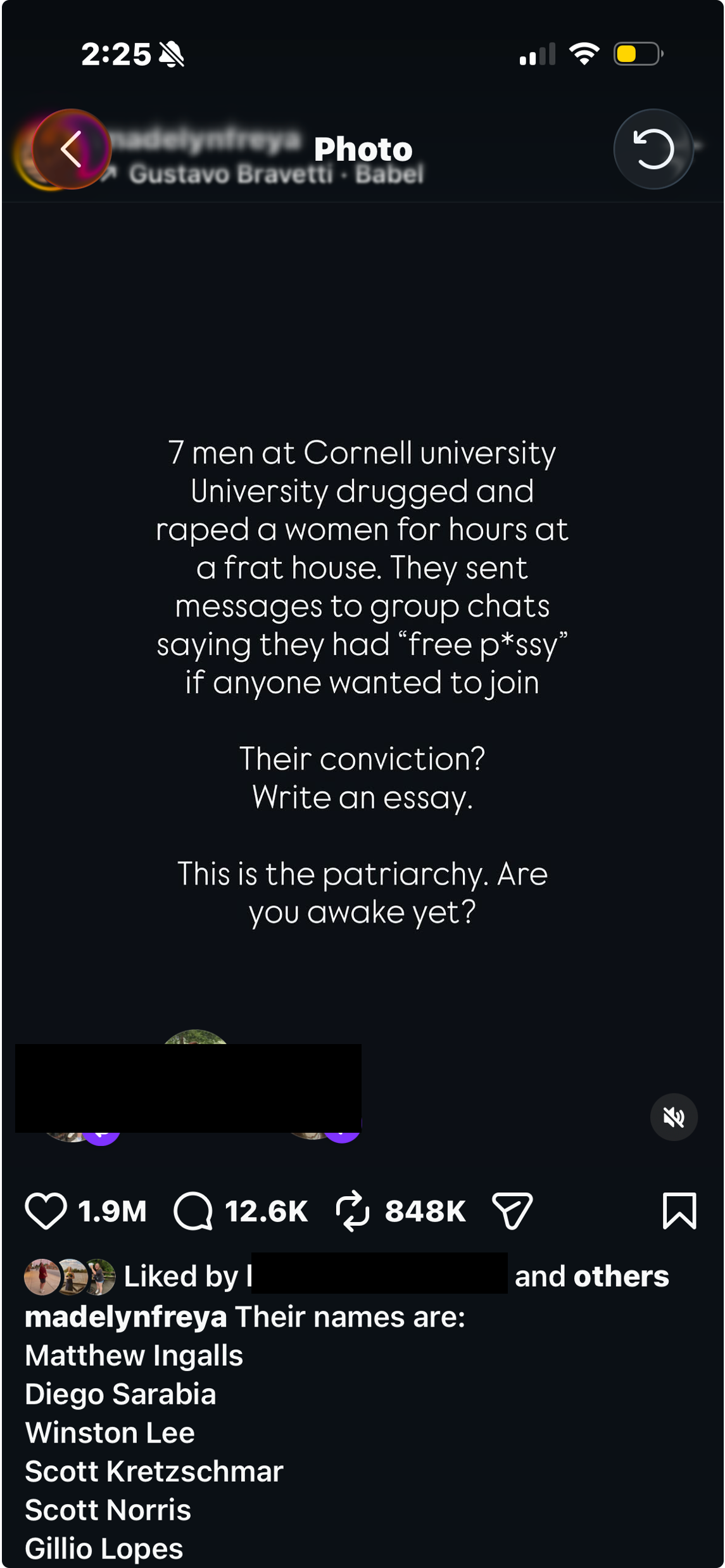
The post obviously references the controversial case at Cornell University involving a young woman and seven fraternity members, and is perfectly designed for social media culture:
Sexual assault. Seven men. One woman. Privilege. Patriarchy. Outrage.
The post was designed to make you angry, not to make you think.

That’s why I thanked God for my 17-year-old’s response. We are raising an entire generation in a digital environment that doesn’t merely expose young people to ideas. It increasingly sorts them into tribes. The algorithm learns what makes them angry, afraid, or excited, then feeds them more of it.
One video leads to another, outrage compounding upon outrage. Eventually, a person can become passionately committed to a worldview without ever realizing how much of that worldview was constructed for them completely by the content they consume.
That’s how polarization can become extremism.
As is always the case, the actual story is far more complicated than a screenshot.

The woman reported the incident to Cornell police in 2024. Her account included heavy drinking and drug use, including ketamine, and she described engaging in some consensual threesomes and orgies earlier in the evening because she found the young men attractive. But she also described becoming increasingly incapacitated, experiencing gaps in her memory, and being coerced later in the evening. In her interview with police, she ultimately said she was certain she had been raped.
The district attorney who declined to bring criminal charges in 2024 says his office relied on her written statement and did not receive the full police interview containing that later allegation. Now that the interview has become public, the investigation has now been reopened.
Meanwhile, the school also conducted its own disciplinary process and says students received sanctions that included suspensions and expulsions. The fraternity chapter was barred from campus. So the viral claim that seven men were convicted of rape and their punishment was simply to write an essay isn’t accurate. It’s also important to remember that none of the seven men has been criminally convicted of rape, and the allegations in the newer civil lawsuit still have to be adjudicated.
My point isn’t to decide from a distance exactly what happened that night. That’s what the investigation and trial will do. The point is to say that the real story is complicated.
If you’ve haven’t heard, the internet has no time for complicated. It’s hard to hold people’s attention and engage them through complicated.
Villains and victims? Choosing a side and hating an enemy? Emotional, 30-second propaganda? That gets people watching.


Christians especially have to be better. Proverbs reminds, “The first to present his case seems right, till another comes forward and questions him,” and later warns, “to answer before listening, that is folly and shame.”
That doesn’t mean we stop caring about injustice. It means we commit ourselves to listening before we speak.
We can take allegations of sexual assault seriously while recognizing that allegations are not convictions.
We can care about an accused person’s right to justice without dismissing the person making the accusation.
We can become angry about evil without allowing our anger to determine what we believe happened.
The Christian word for that is discernment, and we’ve never needed it more than we do today.
It’s hard to imagine a time when it’s been more important for Christians to remember:
Feeling strongly about something isn’t evidence that we understand it.
Having thousands of people agree with us in a comment section doesn’t make us right.
Discovering that a story confirms everything we already believe about the other side should probably make us more cautious, not less.
Radicalization thrives on certainty without understanding.
We need a generation that cares deeply about the world around them while learning to discipline that passion with truth, to slow down before joining the mob, to investigate before condemning, and listen carefully before speaking confidently.

My daughter saw something designed to make her angry, and instead of immediately reacting, she asked a question:
“Is this real, or is it propaganda?”
That’s a pretty good question for all of us.
Because Christians aren’t called merely to have convictions.